

Outsourcing a role to the Philippines typically costs 55–75% less than hiring the same role in Australia. An in-house customer service representative in Australia earns roughly AUD 75,000–92,000 a year (salary, super, leave benefits, and among others) whilst an outsourced staff in the Philippines get roughly around AUD 25,000–38,000 a year, all-in.
This percentage gap is the same for other roles such as back-office, admin support, and VAs. However, the rate changes with highly specialised roles or senior positions.
Why this comparison is usually done wrong
One of the most common mistakes Australian business owners make is comparing an Australian base salary to a Philippine quoted hourly or monthly rate. Remember, you still need to adjust either figure to reflect the full cost of employment. Both sides still have “hidden” costs or additions. Here they are:
- In Australia, the cost of employment sits 25–40% above base salary once you add superannuation (12%, uncapped, from 1 July 2025), leave entitlements, payroll tax (once you’re above your state threshold), workers’ compensation insurance, and recruitment/onboarding costs.
- In the Philippines, the quoted staff-leasing rate is usually already “all-inclusive”. The rate includes statutory contributions (SSS, PhilHealth, Pag-IBIG), 13th-month pay, the provider’s management/service fee, and basic IT/seat infrastructure. However, there are other providers who quote base wage only and add the above as extras. Thus, it is still worth confirming what’s included on the rate.
To help you make an accurate decision, we highly recommend to compare the “all-inclusive” cost to the base rate plus the extras.
How the Australian side is calculated
Base Salary × 1.25–1.40 (to account for the 12% Superannuation Guarantee, leave entitlements ~13%, workers’ compliance, and state payroll tax)
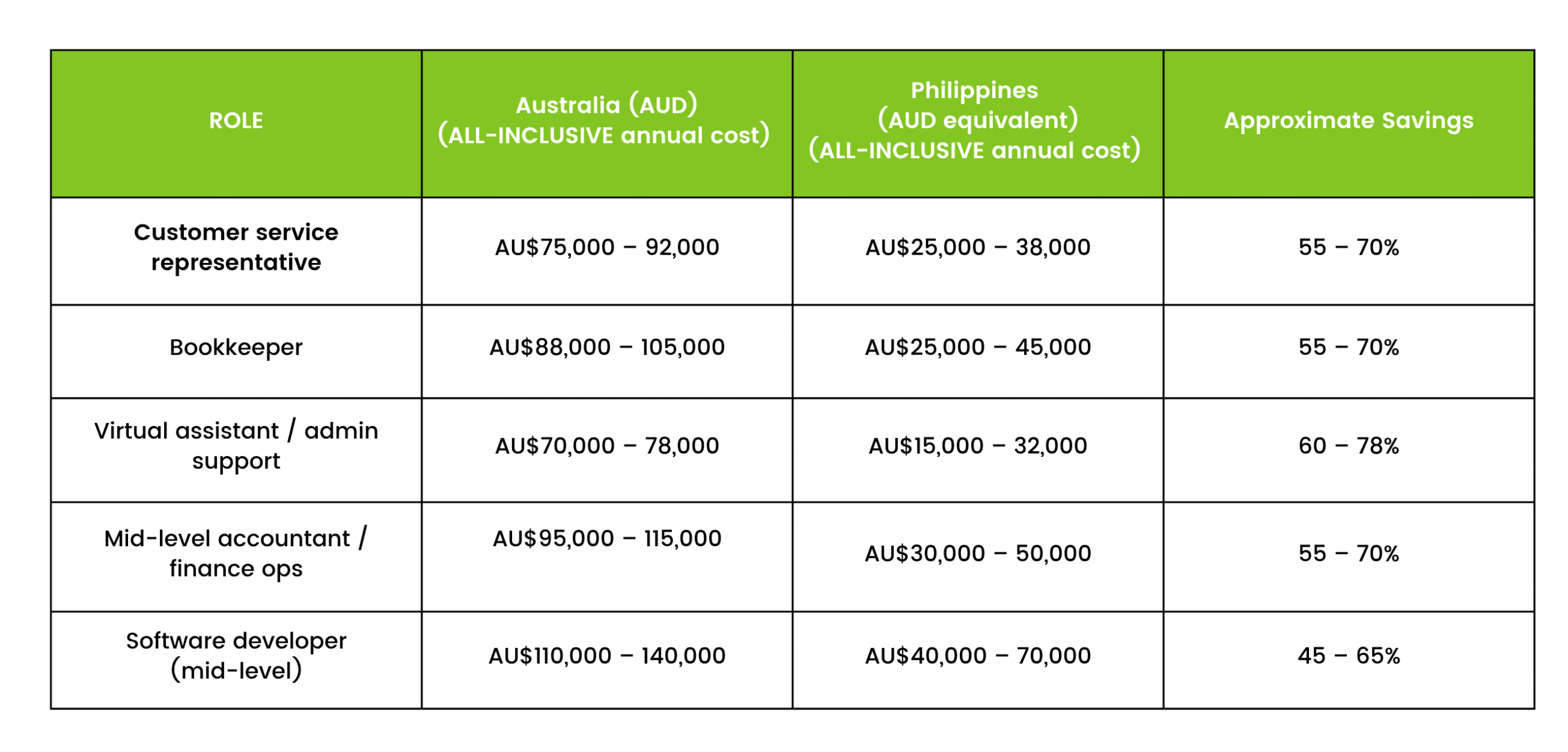
(**base salary is based on SEEK/Indeed/PayScale 2026 averages)
How the Philippine side is calculated
Typical 2026 staff-leasing all-in monthly rates reported by Philippine outsourcing providers, which already bundle wage, statutory benefits, 13th-month pay, and provider management fee.
What’s actually included in a Philippine outsourcing rate?
If you are outsourcing in the Philippines, a legitimate, transparent all-in outsourcing rate should include:
- Direct salary – roughly 55–65% of the total rate
- Statutory contributions – SSS, PhilHealth, Pag-IBIG (employer share)
- 13th-month pay – a mandatory year-end accrual, roughly 1/12th of base salary
- Provider management/service fee — covers recruitment, HR, IT, and tools
- Seat/infrastructure cost — office space, equipment, VDI or laptop, internet redundancy
What to ask an outsourcing provider before signing
Don’t forget to ask about service incentive leave (usually 5 days minimum), night-differential pay (for graveyard-shift AEST coverage), and replacement costs. These are usually included in the package rate or may be billed separately. These are usually the most common places “hidden costs” appear.
Does location within the Philippines change the price?
Yes.
Metro Manila, specifically in Makati and Bonifacio Global City (BGC), has the highest talent density but also the highest cost. However, there are also secondary hubs which typically run cheaper. Here are some of them:
- Metro Manila has the highest cost, but highly recommended for complex or FinTech-grade work.
- Clark in Pampanga is roughly 1 to 2 hours north of Manila. It has lower cost for office, utility and labour as compared to Manila. Plus, it has freeport tax incentives for outsourcing providers. Clark has also its own international airport. You can outsource customer support and back-office work, as well as specialised and seniority roles like software development, marketing, and accounting, among others. It has lower cost of living as compared to Manila, making the outsourcing rates more affordable.
- Cebu, Davao has roughly 10–15% lower cost than Manila.
- Iloilo, Bacolod has roughly 20% lower cost, and typically lower staff attrition.
If you are an Australian SME looking to outsource standard back-office or support functions, a secondary-city, such as Clark, is often the better value-for-quality and cost as compared to Manila. Plus, Clark’s proximity to Manila (about a 2-hour drive) and its own international airport, makes it an easy add-on if you ever want to visit in person.
Does time zone actually work for Australian businesses?
Yes.
This is one of the practical advantages the Philippines has over other outsourcing countries like India or Eastern Europe.
The Philippines runs on GMT+8, which overlaps with AEST (GMT+10) for most of the standard business day without either side needing an overnight shift.
A Philippine team working 9 am to 6 pm local time is already online from roughly 11 am to 8 pm AEST.
Frequently Asked Questions (FAQ)
Is outsourcing to the Philippines legal for an Australian business?
Yes.
There’s no restriction on an Australian company engaging a Philippine BPO, staff-leasing provider. What you can’t do is directly employ a Philippine resident under an Australian employment contract without a local legal structure. That’s why staff leasing and BPO models exist as the standard entry points.
What’s the difference between staff leasing and BPO?
Staff leasing (also called “seat leasing” or a dedicated team model) means you manage the work day-to-day and the provider handles local employment, payroll, and compliance.
A BPO manages an entire process or function on your behalf, end-to-end.
How much does a Filipino virtual assistant cost, all-in?
Roughly around AUD 1,100 to AUD 3,050 per month, depending on experience level, hours, and whether you go through a managed provider or hire a contractor directly. You can contact us so we can give you an accurate cost for your needs and requirements.
What’s the biggest hidden cost businesses miss?
On the Philippines side, you need to ask for the 13th-month pay and service incentive leave, if they are not yet included in the quoted rate.
How long does it take to onboard an outsourced team member?
For a standard role through an established staff-leasing or BPO provider, expect roughly 2 to 4 weeks from signing to your new team member’s first day. This covers candidate shortlisting, your final interview/approval, contract signing, and equipment/system setup. Highly specialised roles (senior finance, niche dev work) can take longer simply because the talent pool is narrower.
What happens if the outsourced staff member doesn’t work out?
Some providers include a replacement guarantee in their contract, typically covering the first 30 to 90 days at no extra cost if the match isn’t working. Before signing, you may ask about what the replacement window is, whether there’s a fee after that window, and how quickly a replacement candidate is usually sourced.
Can I outsource just one role, or do I need a minimum team size?
Most providers support single hires. Meaning, there’s no requirement to build a full team yet. On the other hand, some larger BPOs do set minimum seat counts for dedicated-team pricing. So if you’re a solo founder or small business, it’s worth confirming a provider’s minimum before you shortlist them.
How do I pay an outsourced Philippine team (AUD, USD, or PHP)?
It depends on the provider. Many international BPOs invoice in USD, some newer providers invoice in AUD directly, and a smaller number will let you pay in PHP if you’re managing payroll more directly.
What’s the minimum contract length for outsourcing to the Philippines?
It varies widely. Some providers offer month-to-month with no lock-in. While there are some that requires 6 to 12-month minimum term, especially for dedicated/managed team models.
Shorter terms usually cost slightly more per seat, while longer commitments often come with a modest discount.
Moreover, always confirm exit terms and notice periods before signing.
Do outsourced staff get public holidays off, Australian or Philippine ones?
Typically Philippine public holidays, since that’s where the staff member is legally employed. This is worth planning around, as PH and AU holiday calendars don’t align.
Some providers offer holiday coverage or shift swaps for teams supporting AU business hours. It is worth to ask how this is handled before you commit to a support-heavy role like customer service.
Ready to See What Outsourcing Could Save Your Business?
The numbers in this blog are only industry estimates. Rates will still depend on the role, work hours, and skill level. If you want a real and accurate quote based on your specific business, we can help.
We can walk you through what a Philippine team would look like for your operations, with transparent, all-in pricing and no lock-in surprises.
Contact us today for a consultation.
Sources & Further Reading
Philippines outsourcing cost data
- Piton-Global — BPO Philippines: 2026 TCO & Wage Analysis
- Sourcefit — The True Cost of Outsourcing
- GigaBPO — Outsourcing Rates in the Philippines 2026
- hammerjack — Philippines Outsourcing Costs in 2026
- Smart Outsourcing Solution — How Much Does Outsourcing Cost in the Philippines?
- iSuporta — Philippines Outsourcing Costs 2026
- Splace BPO — What Offshore Hiring in the Philippines Actually Costs in 2026
- More Staffing — Cost to Hire a Filipino Employee (2026 Guide)
Australia employment cost data
- PayScale — Customer Service Representative (CSR) Salary AU
- SEEK — Customer Service Representative Salary Guide
- Indeed — Bookkeeper Salaries in Australia
- Outbooks — Cost of Hiring a Bookkeeper in Australia 2026
- Scalesuite — Bookkeeping Salaries in Australia: 2026 Guide
- Multiplier — Cost of Employment in Australia 2026
- Webco Talent — Real Cost of an Employee in Australia 2026
- teamed. — Australia Employer Cost Breakdown 2026
Exchange rate
- Forbes Advisor — AUD to USD (~1 AUD = 0.717 USD, August 2026)
Figures in this article are 2026 estimates synthesized across the publicly available sources above and are indicative only, not a single authoritative dataset.
If you need a specific quote for a role, seniority level, and shift requirements, you may contact us.